

After spending more than four months in her South African wintering ground, a young female Amur falcon named ‘Alang’ has returned to India for a stopover after a nonstop journey of around 6,000 km across the Arabian Sea. Alang, who was satellite tagged in November 2025 at Chiuluan village in Tamenglong district, Manipur, by scientists from the Wildlife Institute of India, is being tracked during her extraordinary and long journey and migration from Africa to India.
This small bird of prey started its journey from the Somalian coast in May 2026 and undertook nearly 6,000 km of nonstop flight across the Arabian Sea toward the Indian mainland. Experts regard this nonstop flight from the African coast to the Indian mainland as one of the longest over-ocean journeys undertaken by a small raptor.
Scientists from WII tagged the raptor last year in Manipur, India, and continuously tracked its movement using satellite telemetry. The satellite telemetry provides real-time information about migration routes, flight speed, resting places, and survival challenges.
Monitoring of Alang is part of the Manipur Amur Falcon Tracking Project—Phase II, a joint research project between the Wildlife Institute of India and the Manipur Forest Department, supported by the Ministry of Environment, Forest, and Climate Change. The same team is also monitoring two other tagged falcons, Apapang and Ahu, in addition to Alang. Apapang completed a 4,750 km non-stop flight from Somalia to central India in about 95 hours.
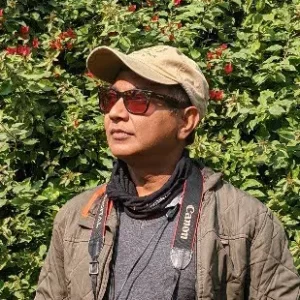
Mr. Vibhav Srivastava is a seasoned wildlife biologist and ecotourism professional with over 20 years of experience across wildlife research, forest management, conservation education, and sustainable tourism in India.
Currently at Nature Safari India, he curates immersive wildlife experiences, leads conservation communication, and designs educational outreach programs. His expertise spans both in-situ and ex-situ conservation, with extensive field work in all major wildlife landscapes of Central, Northern, Eastern, and Southern India. Notable contributions include all-India tiger monitoring with the Wildlife Institute of India, community-based conservation initiatives, and training forest staff and nature guides.
He has held key roles with RARE India, National Zoological Park (New Delhi), Le Passage to India, Tiger Protection Group, and served as Chief Naturalist at Kanha National Park, deepening his expertise in biodiversity conservation and human-wildlife interactions.
An accomplished educator and communicator, Mr. Srivastava has delivered over 30 lectures at prestigious institutions including Delhi University, BHU, Amity University, and IITTM. He is a published author and researcher, with co-authored books, scientific publications, and paper presentations at national seminars. His work consistently bridges conservation science, community engagement, and responsible tourism.
He holds a Master’s degree in Botany, has received professional training from the Wildlife Institute of India, and was nominated among the top five naturalists in India for the TOFT Best Naturalist Award.
