

Rajaji Tiger Reserve, once known for good tiger numbers, has lost its tigers to the increasing urbanization and linear intrusion and is now restoring the tiger population in its western part by reintroducing the tigers from Corbett Tiger Reserve, which is an already established stronghold of tigers in Uttarakhand state.
The Rajaji Tiger Reserve is a crucial protected area located in the Himalayan foothills and Terai landscape in India. The reserve is known as the westernmost limit of tiger distribution in the world. Apart from tigers, the reserve is a stronghold of Asian elephants and supports one of the highest densities of leopards in India. Both Rajaji and Corbett are situated in similar landscapes and support similar habitat types with the same flora and fauna. Both are connected by several wildlife corridors, which allow movement of big animals like tigers and elephants, but in the last few years, due to encroachment and linear intrusion, these corridors have become fragmented, which has resulted in less movement of wildlife and frequent human-animal conflict.
The western part of the Rajaji lost all its tigers, and it was decided by the Uttarakhand forest department, the Wildlife Institute of India, and WWF-India to relocate some tigers from the Corbett tiger reserve in 2020. In phase one of the relocations, five tigers have already been relocated successfully to Western Rajaji. Among five tigers relocated, two were male and three were female. For the second phase, the proposal has already been sent to the National Tiger Conservation Authority (NTCA), which is likely to get the approval post-monsoon.
This fresh reintroduction plan will help increase the population of tigers in the western part of the Rajaji Tiger Reserve, which boosts ecotourism and the local economy. Simultaneously, it will also give nature travelers a new wildlife destination that is not less than the world-famous Corbett Tiger Reserve.
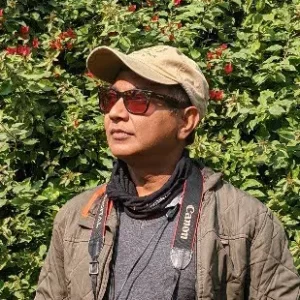
Mr. Vibhav Srivastava is a seasoned wildlife biologist and ecotourism professional with over 20 years of experience across wildlife research, forest management, conservation education, and sustainable tourism in India.
Currently at Nature Safari India, he curates immersive wildlife experiences, leads conservation communication, and designs educational outreach programs. His expertise spans both in-situ and ex-situ conservation, with extensive field work in all major wildlife landscapes of Central, Northern, Eastern, and Southern India. Notable contributions include all-India tiger monitoring with the Wildlife Institute of India, community-based conservation initiatives, and training forest staff and nature guides.
He has held key roles with RARE India, National Zoological Park (New Delhi), Le Passage to India, Tiger Protection Group, and served as Chief Naturalist at Kanha National Park, deepening his expertise in biodiversity conservation and human-wildlife interactions.
An accomplished educator and communicator, Mr. Srivastava has delivered over 30 lectures at prestigious institutions including Delhi University, BHU, Amity University, and IITTM. He is a published author and researcher, with co-authored books, scientific publications, and paper presentations at national seminars. His work consistently bridges conservation science, community engagement, and responsible tourism.
He holds a Master’s degree in Botany, has received professional training from the Wildlife Institute of India, and was nominated among the top five naturalists in India for the TOFT Best Naturalist Award.