

Madhav National Park is a newly declared tiger reserve in Madhya Pradesh, the heart of India. The national Park is the oldest national park of Madhya Pradesh and is located on the northern edge of the Central Indian Highlands. It is part of the Upper Vindhyan Hills and features a mixed geography of plateaus and valleys. The slopes on hills are mostly gentle and not too steep.
Madhav Tiger Reserve is a remarkable mix of natural beauty, history, and architecture. The core area of the tiger reserve is 375.233 sq.km. and the buffer is 1276.154 sq.km.

The Shivpuri District of Madhya Pradesh is home to the Madhav National Park, also known as the Madhav Tiger Reserve. It is relatively close to the town of Shivpuri. It was declared a national park in the year 1958 and a tiger reserve in March 2025, which makes it the 58th tiger reserve of India.
The Park is unique, hosting all types of ecosystems of the central Indian highlands, which include lakes, grassland meadows, and forests.
In the southern portion of the reserve, two lakes, Sakhya Sagar and Madhav Sagar, are situated. They are home to many aquatic species of birds, reptiles, amphibians, and fish, and constitute a lifeline for land-based animals.
These lakes not only add to the aesthetics of the park, but they also give animals a place to live and a steady supply of water throughout the year. They are also a great wetland habitat for aquatic animals, including thousands of migratory waterfowl.
There are a lot of marsh crocodiles at Sakhya Sagar Lake. Because of this, the lake seems like a “Crocodile Safari,” which attracts a lot of people. Madikhera dam sits in the northwestern region of the park.
History:
The core zone of the tiger reserve was part of the royal hunting preserve of the Maharaja of Gwalior. Sir Madhav Rao Scindia, one of the most visionary maharajas of Gwalior, constructed dams on the Manihar river, which created the lakes Sakhya Sagar and Madhava lakes in 1918-1919. Also built many buildings, such as the Sultana Hotel, shooting boxes, and a fine network of metalled roads.
He also did so much work for the conservation and protection of wildlife in the area, and because of that, the area supported spectacular wildlife, including tigers.

Shivpuri forests were famous for their large-sized tigers, which were mentioned twice in the shikar chronicles. E. P. Gee, in his famous book on Indian wildlife, has written that Lord Hradinge, in 1916, shot a tiger measuring eleven feet six and a half inches. Another tiger shot by Lord Reding in 1924 was measured eleven feet five and a half inches.
Dr. George Schaller, in his classic book ‘The Deer and the Tiger’, mentioned that the park supported a good number of predators and pray base. Col. Keshari Singh also mentioned in his book that tigers were so numerous in this area.
Flora and Fauna of Madhav Tiger Reserve
Flora:
The forests of the reserve are mainly of the category of Northern tropical dry deciduous forests. Major species of trees are Kardhai (Anogeissus pendula), Dhaora (Terminalia anogessiana), and Khair (Senegalia catechu).
The shrub species that form the understory of the forest mainly comprise Ber (Ziziphus mauritiana), Makor (Solanum nigrum), and Karonda (Carissa carandas). The forests of Kardhai are found throughout the park in different proportions. The forests of Salai (Boswellia serrata) mostly occur on the higher plateaus and on hilltops.
It is also found on the slopes of the warmer aspects. Mixed deciduous forests are limited to the core area only. These types of forests occur on flat, relatively good, well-drained soils.
The species composition in mixed types of forests includes Bahera (Terminilia bellirica), Chichwa (Albizia odoratissima), kasai (Albizia odoratissima), Jamun (Syzygium cumini), Mitragyna, Ficus, Safed Siris (Albizia procera), and Kusum (Schleichera oleosa). There is a small patch of Teak (Tectona grandis) forest found along the national highway.
Pure grasslands do not exist in the forest; the areas close to Sakhya Sagar Lake provide good grasslands. In some other areas, like in the north range and in the extension area, there are good grasslands.

Fauna:
The faunal assemblage in the reserve represents a typical central Indian highlands fauna, which includes tiger and leopard, are the major predator while spotted deer, nilgai or bluebull, and chinkara or Indian gazelle are the most common ungulates found in this reserve.
The areas surrounding two lakes are the major spots where chital can be spotted. Sambar deer are also found in some areas where the forest cover is dense, especially in the eastern part of the reserve.
Also, there are occasional sightings of wild dogs and wolves, jackal and hyenas are common. Both lakes have a good number of Marsh Crocodiles, and one can see them basking in the sun during winter. Small mammals include Jungle cat, palm civet, small Indian civet, otter, fox, porcupine, monitor lizard, black-naped hare, etc.
More than 229 species of birds have been reported from the reserve. During winters large numbers of migratory birds visit the area, especially the two lakes. These birds include Demoiselle cranes, spotbill duck, pelicans, spoonbills, shovellers, comb duck, bareheaded geese, Brahminy duck, etc.
Cobra and common krait are common venomous snakes. The Indian python is occasionally seen. Monitor lizards are also common.
Places of Interest in the reserve.
The lakes and sailing clubs:
There are two lakes in the reserve, the Sankhya Sagar and Madhav Sagar, both of which attract large numbers of migratory birds during winter. There is a sailing club near Sankhya Sagar Lake where visitors can go boating. There is also a guesthouse at the Sailing Club.
George Castle:
A famous historical place that was built by Jivaji Rao Scindia in 1911 on top of a hill for British king George V for his stay. The castle was used by the British army and the members of the Royal families during their hunting expedition.
Nature trail:
To give insights into the functioning of the forest ecosystem and its various component nature trails have been created by the forest department for tourists and nature enthusiasts.
View all tiger reserves and national parks in India.

Conservation Success Story
Starting in the year 2023, three tigers were reintroduced in the Madhav tiger reserve to boost the population of this big cat. On 10th March 2023 one 4 years old male tiger from Satpura and a three and half years old female tigress from Bandhavgarh were reintroduced in the reserve.
Three days later, another female tigress from the Panna tiger reserve was relocated. In the second phase of the project, a tigress from Panna tiger reserve and a male tiger from Bandhavgarh were relocated to Madahav. A camera trap image showed that one of the tigresses is with two cubs, which gives hope for the tiger recovery in the reserve.
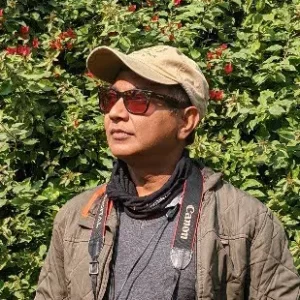
Mr. Vibhav Srivastava is a seasoned wildlife biologist and ecotourism professional with over 20 years of experience across wildlife research, forest management, conservation education, and sustainable tourism in India.
Currently at Nature Safari India, he curates immersive wildlife experiences, leads conservation communication, and designs educational outreach programs. His expertise spans both in-situ and ex-situ conservation, with extensive field work in all major wildlife landscapes of Central, Northern, Eastern, and Southern India. Notable contributions include all-India tiger monitoring with the Wildlife Institute of India, community-based conservation initiatives, and training forest staff and nature guides.
He has held key roles with RARE India, National Zoological Park (New Delhi), Le Passage to India, Tiger Protection Group, and served as Chief Naturalist at Kanha National Park, deepening his expertise in biodiversity conservation and human-wildlife interactions.
An accomplished educator and communicator, Mr. Srivastava has delivered over 30 lectures at prestigious institutions including Delhi University, BHU, Amity University, and IITTM. He is a published author and researcher, with co-authored books, scientific publications, and paper presentations at national seminars. His work consistently bridges conservation science, community engagement, and responsible tourism.
He holds a Master’s degree in Botany, has received professional training from the Wildlife Institute of India, and was nominated among the top five naturalists in India for the TOFT Best Naturalist Award.
